
David Bowie on Creativity and The Collective Force Behind his Greatest Hits
The most transformative art emerges not from isolation, but from the electric tension between authenticity and community.

When David Bowie stepped onto stages across the world, he wasn't just performing music, he was demonstrating a radical truth about creativity that most of us have forgotten. In a culture obsessed with solo achievement and individual brilliance, Bowie understood something profound: the most transformative art emerges not from isolation, but from the electric tension between authenticity and community.
Bowie's creative process was defined by a blend of personal vision, experimentation, and collaboration. His openness to new ideas and willingness to work closely with others were central to the creation of his most celebrated works. Whether through innovative songwriting techniques or dynamic partnerships, Bowie's masterpieces are a testament to the power of creative synergy.
Individual Vision Meets Collective Power
David Bowie's advice to artists was deceptively simple:
"Never play to the gallery… Always remember that the reason that you initially started working is that there was something inside yourself that you felt that if you could manifest in some way, you would understand more about yourself and how you coexist with the rest of society. I think it's terribly dangerous for an artist to fulfill other people's expectations — they generally produce their worst work when they do that."
But here's where it gets interesting: while Bowie advocated for not creating for others, he was a pro at creating with others. His breakthrough came through creative partnerships, experimental techniques, and a willingness to venture into uncharted creative territory.
Creative Techniques and Approaches
Cut-Up Technique: Bowie often used the "cut-up" method for writing lyrics, a process originated in Dadaism, where he would write out lines, cut them up, and rearrange them to generate surprising new combinations and ideas. This technique helped him break creative blocks and discover unexpected lyrical directions.
Self-Imposed Limitations: To spark creativity, Bowie would sometimes restrict himself to a limited set of chords or musical ideas. He believed that narrowing his options could lead to more inventive songwriting, as it forced him to work within constraints and find unique solutions.
Environmental Influence: Bowie drew inspiration from his surroundings. The location where he wrote music, whether the mountains of Woodstock or the streets of New York, would often influence the mood, sound, and themes of his work.
Going Deeper: Bowie's most important creative advice was about courage: "If you feel safe in the area that you're working in, you're not working in the right area. Always go a little further into the water than you feel you're capable of being in. Go a little bit out of your depth, and when you don't feel that your feet are quite touching the bottom, you're just about in the right place to do something exciting."
Collaboration as a Cornerstone
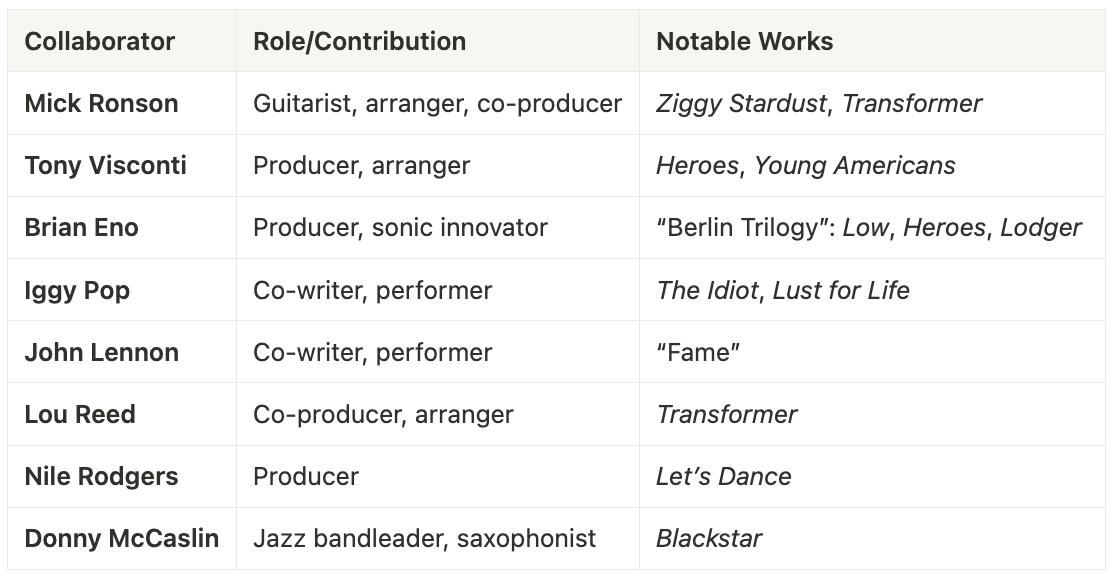
Bowie's masterpieces were frequently the result of rich collaborations with other artists, musicians, and producers. He was known for surrounding himself with talented partners who could challenge and inspire him.
Bowie was adept at bringing together musicians with distinct styles and giving them the freedom to contribute their own ideas. He worked with guitarists like Carlos Alomar, Earl Slick, and Stevie Ray Vaughan, as well as producers like Nile Rodgers and Tony Visconti, each of whom left a unique mark on his music. Pianist Mike Garson noted that Bowie was the best producer he had ever worked with because "he let me do my thing."
This is how you reach freedom to be authentic while being part of a creative collaboration.
Some of the Remarkable Results of his Collaborative Creative Processes
"Heroes": Created with producer Tony Visconti and guitarist Robert Fripp, this track is a testament to Bowie's collaborative spirit. Visconti described the recording session as a masterclass in creative teamwork, with each musician bringing their own expertise to the process.
Berlin Trilogy: Working with Brian Eno in Berlin, Bowie embraced avant-garde techniques and electronic sounds, resulting in some of his most innovative albums. Eno's influence encouraged Bowie to experiment further with structure and sound.
Iggy Pop: Bowie co-wrote and produced much of Iggy Pop's early solo work, including The Idiot and Lust for Life. Their partnership was symbiotic, with each artist inspiring the other's creative direction.
"Fame": This hit was born from a jam session with John Lennon. Lennon contributed backing vocals and guitar, and the spontaneous, collaborative nature of the session shaped the final song.
Key Collaborators
What We Can Learn from Bowie's Approach
Bowie's creative legacy teaches us that the tension between individual authenticity and collaborative creativity isn't a contradiction, it's the source of transformative art. He showed us that we can maintain our unique voice while drawing strength, inspiration, and innovation from our creative communities.
In our hyper-connected yet often isolated world, Bowie's approach offers a roadmap for sustainable creative living. We don't have to choose between artistic integrity and collaborative support. We can, like Bowie, venture into deeper creative waters precisely because we're not swimming alone.
The most radical creative act isn't suffering in isolation, it's having the courage to create authentically while building the communities that will challenge, support, and amplify our work. As Bowie proved throughout his chameleon-like career, the greatest art emerges when individual vision meets collective power.